Anycubic Photon P1 Resin 3D Printer Review UK 2026
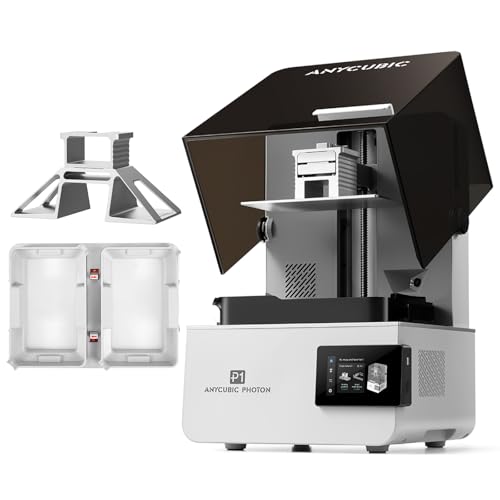
Quick verdict
Score: 6.7/10
Best for: Hobbyists printing highly detailed miniatures, figurines and models
Not for: Anyone needing large or functional parts, or who can't manage resin washing, curing and ventilation
Bottom line: A resin 3d printer, a detail-focused choice for miniatures and detailed models.
The Anycubic AMZ-PPC1BK0A-1 Photon P1 (Photon P1) resin 3D printer is built around dual-colour or dual-material printing, ultra-precise motion, and automated monitoring, aimed at consistent detail and repeatable results. Its standout strength is predictable accuracy, with dimensional tolerance under 0.05mm, while the intelligent assistant 3.0 system monitors conditions during prints and can adjust parameters to reduce failures.
Key specifications
| Spec | What it does Practical impact |
|---|---|
| Dual color/material | Uses two resins in a single job Less waste on small parts |
| 14K mono screen | Controls pixel exposure More consistent detail |
| Ball screw core | Drives motion with core accuracy focus Stable dimensions |
| Tolerance <0.05mm | Claimed dimensional accuracy Better fit for models |
| Up to 8000cps | Supports very viscous resins Enables engineering-grade material use |
Pros
- Excellent fine detail and smooth surfaces
- Detail-focused resin printing
Cons
- Resin needs washing, UV curing and good ventilation
- Smaller build volume than most FDM printers
- Consumables (filament/resin, nozzles/FEP) add to running cost
Build Volume and Print Size
With a build volume of up to 6.5L, this 3D printer resin printer is suited to users who want to run more than one part at a time, or print larger models in a single batch rather than splitting work into many smaller jobs. This can help small batch manufacturing and educational groups reduce repeated setup across multiple prints. The Anycubic can also support dual-colour prints by placing different sections together.
Print Speed and Quality
Print speed and quality on the 3D printer are best understood as a balancing act between accuracy goals and how consistently the printer can maintain suitable curing conditions during a job. The focus is on consistent output, supported by an industrial-grade ball screw and a 14K mono screen aimed at precision under 0.05mm tolerance. Actual print speed will vary with layer curing and batch size, since faster runs can increase the chance of minor defects. The intelligent assistant continuously monitors conditions and adjusts parameters to reduce failure.
Filament Compatibility
Material handling in the Anycubic connects directly to how consistently it can support solid curing results across different resin types, which is why the printer's compatibility information matters. The 3D printer uk is described as supporting ultra-viscous resins up to 8000 cP, helping it work with tougher engineering blends rather than only low-viscosity hobby resins. It also uses Wave Release Technology to reduce peeling force by 60%, which can assist with resin flow during release.
Build Plate and Levelling
Before a resin job starts, the Anycubic AMZ-PPC1BK0A-1 Photon P1's build plate and levelling become critical, because resin printers can only cure evenly when the plate position is consistent across the whole bed. For the Anycubic, the plate is prepared by confirming it sits firmly, then performing the printer's levelling routine before each print. When the platform is slightly high or low, first layers may thin out or cure inconsistently, so users should recheck after any maintenance. Strengths include stable motion from its ball screw, but repeat accuracy still depends on careful setup.
Software and Slicer Compatibility
Once the build plate is level, the next step for the 3D printer is aligning the slicing workflow with the printer correctly, because resin curing depends on the way a file is exported. For customers purchasing the Anycubic from Amazon UK, compatibility centres on using the correct export format and matching build settings profiles; otherwise prints can fail. The most reliable approach is to select the printer model in the slicer, load a matching resin profile, verify the layer height, and then export. Strength: consistent results when profiles match. Weakness: mismatched firmware or profiles can shift exposure.
Setup and Learning Curve
After the initial unboxing, the 3D printer requires a careful setup routine. Resin printers are sensitive to small setup errors even when the slicing file is correct. The user levels the build platform, confirms the resin tank fits, and checks that the screen area stays clean and dust-free. A short test exposure helps catch incorrect lift or cure timing. Over time, the learning curve is steady, but mistakes such as overfilling or mis-seating the vat can ruin prints. These practical steps shape this 3D printer pros and cons.
Noise and Enclosure
Noise and enclosure matter with the Anycubic because a resin printer's curing process and moving mechanics can create distractions in a shared room. The printer's operation typically includes sound from motion stages and periodic screen exposure, so placement matters. Using a door, a mat, or extra distance can help. The Anycubic AMZ-PPC1BK0A-1 Photon P1 also benefits from an enclosure approach that limits light spill and contains resin odour. Buyers should expect moderate room impact and plan accordingly.
Cleaning and Maintenance
For resin users, cleaning and maintenance help keep prints consistent over time and support safe handling between jobs. The routine starts immediately after a print: uncured resin is removed from the build plate and the vat surface to prevent film buildup. The mono screen area is then checked for any residue, since debris can blur details and increase failures. After washing, parts should be fully cured before storage. Between sessions, the vat should be covered to limit exposure, and gloves are recommended for handling resin safely.
Who Is This 3D Printer For?
Anyone considering the 3D printer should start with their resin workflow needs, because resin handling and after-print care strongly shape day-to-day practicality. This printer suits makers of high-detail models, dental models, and engineering prototypes, with the manufacturer claiming under 0.05mm tolerance. The AMZ-PPC1BK0A-1 also targets users who want a 6.5L build volume for batch printing. It is positioned for managing ultra-viscous resins up to 8000cps, but it may be less suitable for casual beginners.
Where to Buy in the UK
Finding this 3D printer in the UK depends on choosing a retailer that sells resin 3D printers with clear after-sales support, since the workflow relies on correct resin handling. Buyers typically compare UK listings from major online marketplaces and specialist 3D printing shops, then check whether the Anycubic best price uk claim matches what is included and the intended resin type. They should also confirm the returns process, because failures can require support. Some sellers may list options for dual colour workflows, but availability is not consistent.
Frequently Asked Questions
Is the 3D printer good for beginners and home use?
The Anycubic is usable at home by beginners willing to learn the basics. Expect a short learning curve around slicing and resin handling, after which home printing is straightforward.
Is the 3D printer an FDM or resin printer, and what is the difference?
The Anycubic AMZ-PPC1BK0A-1 Photon P1 is a resin (LCD/MSLA) printer. Resin gives the finest detail for miniatures and models, but every print must be washed in IPA and UV-cured in a ventilated space.
Is this 3D printer worth it?
If you enjoy making detailed miniatures and models, a printer like the Anycubic pays off over time. Factor in resin, IPA and curing supplies as the main ongoing cost, and check the current Amazon UK price.
How much does it cost to run the 3D printer?
Running costs are mainly consumables: resin (plus IPA for washing and replacement FEP film). Electricity use is modest, so budget mostly for resin and curing supplies.
What post-processing does the Anycubic need?
Resin prints must be washed in IPA and cured under UV light. Work in a ventilated area and wear gloves, as uncured resin is an irritant.
What software does the 3D printer use?
This 3D printer works with common slicers such as Chitubox or Lychee, which turn 3D models into printable files.