Creality K2 Pro Combo 3D Printer Review UK 2026
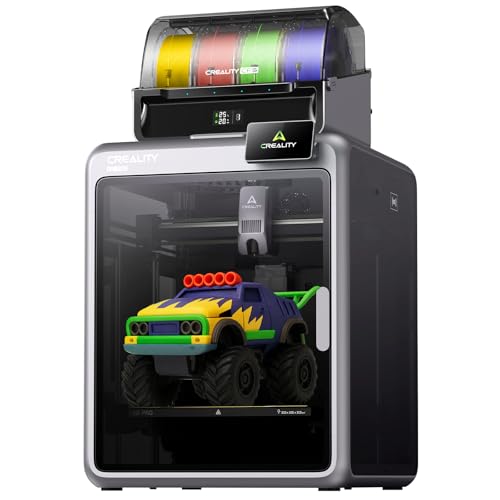
Quick verdict
Score: 7.4/10
Best for: Makers wanting versatile printing of functional parts and larger models
Not for: Those chasing the finest miniature detail - a resin printer suits that better
Bottom line: A FDM 3d printer (300 x 300 x 300 mm, 600 mm/s), a versatile choice for everyday printing.
Often, the Creality K2 Pro Combo is best thought of as a high-speed FDM printer with a practical, large working area, offering a 300 x 300 x 300 mm build volume and a print speed rating of up to 600 mm/s with 20,000 mm/s² acceleration. The standout is its CFS smart filament approach, which supports up to 16-colour, multi-material printing, along with monitoring and auto-leveling to help reduce setup effort. It still depends on selecting the correct filament type such as PLA, ABS, or ASA, and results may vary if models require stable chamber conditions.
Key specifications
| Category | Details |
|---|---|
| Drive/Control | up to 600 mm/s, 20,000 mm/s² |
| Build/Media | 300 x 300 x 300 mm; PLA/ABS/ASA plus PPA-CF and PET-CF; heated chamber up to 60°C; CFS up to 16-colour multi-material printing |
Pros
- 300 x 300 x 300 mm build volume
- Up to 600 mm/s print speed
- Automatic bed levelling
- Supports PLA, ABS, ASA
Cons
- Slicing and first-layer setup take some learning
- Consumables (filament/resin, nozzles/FEP) add to running cost
Build Volume and Print Size
This 3D printer has a 300 x 300 x 300 mm build volume, so it supports printing parts up to that size in length, width, and height without splitting the model. For anyone evaluating the Creality in the UK, this is particularly relevant for larger prototypes and multi-part batches that need to be completed in a single run. Practically, the build size is bounded by the 300 mm limits in all three dimensions, and very tall models can still need orientation changes to fit within the available height. For oversized items beyond those limits, the model would need splitting, which is consistent with most FDM approaches.
Print Speed and Quality
With its up-to 600 mm/s print speed and up to 20,000 mm/s² acceleration, the 3D printer is designed to move quickly while maintaining smooth motion, using an FDM setup with FOC step-servo motors and linear rails. Print speed is balanced with quality controls: an AI camera on the nozzle auto-tunes flow rate in real time, supported by pressure advance tuning to help reduce under- or over-extrusion. Quality also relies on cooling and stability, since active chamber heating maintains up to 60°C to help prevent corner warping on materials like ASA.
Filament Compatibility
Filament compatibility matters on the Creality because it is built to handle more than basic PLA while still requiring correct material settings. The printer supports PLA, ABS, ASA, PPA-CF, PET-CF, and more, enabling softer or tougher part characteristics depending on the chosen filament. It also works with the CFS Smart Filament System, which uses auto filament identification and intelligent feeding. For best results, temperature and flow must match the selected filament, otherwise under-extrusion and poor layer adhesion may occur. Carbon-fibre filament types can print faster but may be more abrasive.
Build Plate and Levelling
Build plate setup on the 3D printer affects first-layer adhesion and links directly to how reliably the selected filament settings translate into a stable print. A key advantage versus older beds is worry-free auto-levelling, which probes only the model's print areas to reduce setup time. Start by cleaning the plate surface, then run auto-levelling, then verify the first layer is even, with no gaps and no excessive squish. If the chamber is heated to 60°C for ASA, warping risk is lower, but tuning is still required.
Software and Slicer Compatibility
Software and slicer compatibility determines how reliably the Creality K2 Pro Combo converts an STL or CAD model into toolpaths, particularly when switching materials such as PLA and ASA. The Amazon listing indicates broad filament support, including PLA, ABS, ASA, and carbon-fibre blends, so slicer profiles need to reflect those material behaviours. The printer includes an auto-tuning capability using its cameras for nozzle flow, but slicing still sets temperatures, speeds, and retraction. G-code should be checked for filament-change sequences and command formatting, as mismatched slicer settings can lead to weak layer bonding.
Setup and Learning Curve
Setting up the Creality typically involves a short but deliberate learning period, because the printer integrates automation features alongside high-speed motion, so early calibration is important. The bed is auto-levelled by probing only model-print areas, followed by a first-layer test to check adhesion. Filament loading then comes next, with the printer's CFS Smart Filament System handling identification and feeding, alongside storage routines designed to keep filament dry. The printer is rated for speeds up to 600 mm/s and accelerations up to 20,000 mm/s², so tuning flow via the nozzle AI camera is important. The 3D printer's pros and cons include faster setup, but it is less tolerant of skipped tests.
Noise and Enclosure
Because the Creality is built for high-speed FDM printing, it can be noticeable in typical home or workshop spaces, particularly during fast moves rated up to 600 mm/s and rapid acceleration rated up to 20,000 mm/s². For day-to-day use, placing the printer on a rigid surface and keeping the enclosure doors closed can reduce perceived vibration. If the printer runs unattended, chamber heating up to 60°C can help stability, but ventilation plans remain necessary.
Cleaning and Maintenance
Regular cleaning helps keep the 3D printer printing reliably, particularly because it is aimed at high-speed FDM work where residue can affect layer quality. After each multi-material run, the printer should be checked and wiped to remove dust and filament dust. Let the nozzle cool first, then brush the nozzle exterior and clean the hotend opening using dry tools only. Inspect the build plate, remove any stuck bits, and re-check auto levelling results before starting a new batch. If a clog occurs, use the quick-swap hotend for fast service, and clear the waste chute if a blockage is suspected.
Who Is This 3D Printer For?
This 3D printer is best suited to people who want fast FDM printing, a large work area, and multi-material runs, rather than only basic single-colour prints. With a 300 x 300 x 300 mm build volume and up to 600 mm/s speed, it fits makers, students, and small studios that batch-print prototypes or multiple small parts. Buyers also interested in "is the Creality any good" should note its CFS smart filament system, which supports up to 16-colour multi-material prints using PLA, ABS, and ASA (and more if supported). This approach comes with more setup than simpler single-extruder printers.
Where to Buy in the UK
For UK buyers weighing the Creality K2 Pro Combo's high-speed FDM build and CFS multi-colour setup against the additional modules in the package, choosing a reliable purchase source matters for day-to-day use. In the UK, shoppers typically compare listings across major electronics retailers and authorised channels, then confirm what is included in the "Combo" package, including whether the CFS smart filament system is part of the delivery. Buyers should also check the stated ready-to-use build volume of 300 x 300 x 300 mm for their intended prints and look for UK-based customer support and parts availability. Where local spares are limited, maintenance downtime can rise, so a clear support route is an important part of the buying decision.
Frequently Asked Questions
Is the Creality K2 Pro Combo printer good for beginners and home use?
Features like automatic bed levelling make the Creality printer approachable for newcomers. Expect a short learning curve around slicing and first-layer setup, after which home printing is straightforward.
Is the Creality K2 Pro Combo printer an FDM or resin printer, and what is the difference?
The Creality printer is an FDM (filament) printer - more versatile and lower-maintenance than resin, and better for functional parts and larger models. Resin only wins on ultra-fine detail.
Is the Creality K2 Pro Combo printer worth it?
If you enjoy making functional parts, prototypes and larger models, a printer like the Creality printer pays off over time. Factor in filament and the occasional nozzle as the main ongoing cost, and check the current Amazon UK price.
How much does it cost to run the Creality K2 Pro Combo printer?
Running costs are mainly consumables: filament, at roughly a few pounds per standard roll, plus occasional nozzles. Electricity use is modest, so budget mostly for filament.
What is the Creality K2 Pro Combo printer's build volume?
The Creality printer has a build volume of 300 x 300 x 300 mm, which sets the largest single print it can produce.
How fast does the Creality K2 Pro Combo printer print?
The Creality printer lists a maximum print speed of 600 mm/s; real-world speeds are usually lower to preserve quality.
What software does the Creality K2 Pro Combo printer use?
The Creality printer works with common slicers such as Cura, PrusaSlicer or the maker's own slicer, which turn 3D models into printable files.