Elegoo Centauri Carbon 3D Printer vs Bambu Lab P1S Combo + AMS 3D Printer
We compare the Elegoo Centauri Carbon 3D Printer and the Bambu Lab P1S Combo + AMS 3D Printer across every dimension that matters - our scores, the key specs, and how each performs on the things you will actually notice day to day.
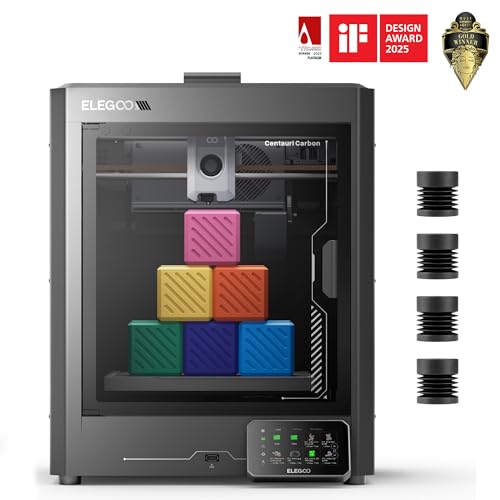

At a glance
| Elegoo Centauri Carbon 3D Printer | Bambu Lab P1S Combo + AMS 3D Printer | |
|---|---|---|
| Our score | 7.9/10 | 8.1/10 |
| Best for | Makers wanting versatile printing of functional parts and larger models | Makers wanting versatile printing of functional parts and larger models |
| Not ideal for | Those chasing the finest miniature detail - a resin printer suits that better | Those chasing the finest miniature detail - a resin printer suits that better |
| Brand | Elegoo | Bambu Lab |
Build Volume and Print Size
Elegoo Centauri Carbon 3D Printer
This 3D printer offers a square build volume of 256 x 256 x 256 mm, making it suitable for medium-sized mechanical parts and larger display models. The cubic envelope supports taller objects provided they fit within the 256 mm height limit and the planned part footprint. The printer arrives fully assembled and pre-calibrated, enabling faster setup for larger prints. Though, layout planning is still needed for multi-part projects.
Bambu Lab P1S Combo + AMS 3D Printer
With its stated size and mass, this 3D printer is positioned as a complete, enclosed FDM system whose main output area depends on the print dimensions it can physically support. For buyers the outer product dimensions are listed as 38.9 x 45.8 x 38.9 cm, and the item mass is 21.6 kg. The manufacturer text does not specify the actual build volume, usable height, or maximum part footprint, which limits what can be planned for large, multi-part prints.
Print Speed and Quality
Elegoo Centauri Carbon 3D Printer
With an advertised print speed of up to 500 mm/s and acceleration of 20000 mm/s², the Elegoo is positioned for fast builds, particularly for larger parts where time matters. Speed is supported by a rigid die-cast frame, auto vibration compensation, and pressure advance, which work together to reduce streaks and uneven extrusion. For print quality, the printer includes an enclosed chamber with improved cooling and a heated bed, so PLA tends to adhere well and warp less. Consistent high-speed output still depends on model geometry and cooling conditions.
Bambu Lab P1S Combo + AMS 3D Printer
Print speed and quality on the Bambu Lab are tied to its published performance features and the printer's enclosed design. Performance is described as printing up to 16 colours with MAS by stacking four units. The manufacturer also claims acceleration up to 20mm/s², plus pressure advance and vibration compensation, designed to keep fine detail stable during faster movements. Setup includes step-by-step actions starting from pressing print, followed by automatic bed levelling and vibration compensation, which can reduce variation. Actual results depend on the selected print model, the print height and the complexity of the design.
Filament Compatibility
Elegoo Centauri Carbon 3D Printer
Filament compatibility on the 3D printer is designed around PLA and then extends to more demanding materials. The manufacturer states it is tailored for "advanced filaments" and specifically highlights carbon fibre reinforced filament. It ships ready to print with PLA, and the enclosed chamber with improved cooling is intended to support use beyond basic plastics. For the Elegoo, the nozzle is described as a 320°C brass-hardened steel nozzle, which is positioned as helpful when moving to carbon fibre reinforced filament. Users should expect tougher parts, while PLA still requires the usual care for adhesion and heat control.
Bambu Lab P1S Combo + AMS 3D Printer
Filament compatibility on the 3D printer depends heavily on its fully enclosed body, because this design helps maintain temperature stability during printing. In the Bambu Lab (P1S + AMS), the enclosed construction supports more consistent results with advanced filaments, compared with open-frame designs. Higher-temperature filaments are more likely to print consistently. For multi-colour work, the AMS system supports switching materials.
Build Plate and Levelling
Elegoo Centauri Carbon 3D Printer
Build plate performance and levelling set the start quality, particularly when printing PLA on a textured surface and later moving to more demanding filaments. The dual-sided build plate includes a PLA-specific surface designed to improve adhesion and limit warping. The printer arrives fully assembled and pre-calibrated, and it uses auto bed levelling, so the first-layer setup is usually quick. For best results, a simple routine is to power on, start the auto level, then run a small test square. If corners lift, the heated bed temperature and first-layer flow may need small adjustments.
Bambu Lab P1S Combo + AMS 3D Printer
Because the P1S Combo is designed as a fully enclosed printer, the build plate and levelling process helps keep conditions stable while layers are formed. The printer is described as having a capability to print up to 16 colours, supported by automatic bed levelling and vibration compensation. Before printing, the user typically selects the model and starts Print, and the system performs calibrations without manual steps. If the results look uneven, the build plate should be cleaned and the job restarted, since long outages can shift surface contact.
Software and Slicer Compatibility
Elegoo Centauri Carbon 3D Printer
Software and slicer compatibility for the 3D printer is mainly about how easily it can take common G-code files and how well those settings suit its enclosed, high-speed FDM setup. Owners can slice STL files into G-code for this enclosed CoreXY printer with a 256 x 256 x 256 mm build volume, then print the resulting G-code from the onboard interface. For users finding it via the Amazon UK listing, the key check is whether slicer profiles support PLA at typical chamber temperatures.
Bambu Lab P1S Combo + AMS 3D Printer
How well does the 3D printer (P1S + AMS) handle everyday software use and file compatibility? The 3d printer relies on the bundled "sophisticated hardware and software, " and it is described as print-ready, so users can start printing without manual calibration steps. File compatibility is positioned as supporting an out-of-the-box workflow. Multi-colour output via the included multi-colour capability is handled through the printer's software workflow, and stacking additional units can extend colour capability. Quick Verdict The software workflow is described as print-ready for immediate use, with multi-colour printing handled through the bundled system.
Setup and Learning Curve
Elegoo Centauri Carbon 3D Printer
Although the Elegoo Centauri Carbon is designed to be straightforward, the setup still takes an organised first session, particularly for first-time users. The Elegoo review notes that the unit arrives assembled and pre-calibrated, so the early steps focus on placement, filament loading, and confirming auto bed levelling operates as expected. The typical first workflow starts with an auto bed level run, followed by loading PLA and checking that the touchscreen controls correspond to the selected profile.
Bambu Lab P1S Combo + AMS 3D Printer
Once the Bambu Lab P1S Combo (P1S plus AMS) is unboxed, the setup process is positioned as straightforward, with the printer described as "complete performance ready to use" and "just click[s] print, " with calibrations handled by the machine. It also supports high temperature printing and includes an enclosed body, which can be relevant when experimenting with advanced filaments. For most users, the learning curve is described as low because automatic bed leveling and vibration compensation reduce tuning. However, whether the Bambu Lab plus AMS 3D printer is any good depends on workflow, since multi-colour use via the AMS requires additional loading steps and careful profile checks.
Noise and Enclosure
Elegoo Centauri Carbon 3D Printer
Because the 3D printer uses an enclosed chamber, it can reduce drafts around the print area, which helps with consistency during longer sessions, particularly when printing PLA. The integrated enclosure also dampens some sound reaching the room, and the rigid die-cast frame helps limit vibration for steadier motion at high speeds. The main trade-off is heat build-up, so normal ventilation is important where the printer is positioned. The enclosure supports consistency, the camera adds a monitoring benefit, and the enclosed design can increase ambient warmth.
Bambu Lab P1S Combo + AMS 3D Printer
Noise and enclosure are central to the P1S Combo's day-to-day use, particularly during longer print runs, where the enclosed plastic body can influence what is noticeable in the room. With this enclosed design, sound containment tends to be the main point of difference versus open-frame comparisons, rather than print speed itself. Motion and filament activity are still audible, but the shell helps reduce direct air movement. The enclosure also supports higher temperature printing for advanced filaments. Strength comes from calmer placement, while the weakness is reduced visual access.
Cleaning and Maintenance
Elegoo Centauri Carbon 3D Printer
Cleaning and maintenance on the Elegoo are mainly about keeping the enclosed printing area, nozzle, and build surface in good condition, so prints stay consistent over time. In this review, routine care starts after each print, when residue on the dual-sided plate and around the chamber is removed gently with a soft brush. The nozzle should be wiped while warm, then any clogs cleared by running short test moves at normal settings. The PLA-specific surface benefits from light cleaning only, because abrasive scraping can reduce adhesion, especially when switching filaments. Finally, the enclosed airflow area should be checked for dust buildup.
Bambu Lab P1S Combo + AMS 3D Printer
After looking at how the enclosed body affects what can be heard during long prints, attention shifts to upkeep. Cleaning routines influence how consistently the 3D printer can perform, and simple, repeatable steps help. First, wipe the exterior and keep the enclosed body dry. Next, check the build plate for stuck residue and gently clean it between jobs. Finally, clear filament dust from vents and around the print path, since buildup can cause feed issues. These practices support the Bambu Lab pros and cons, but they add routine time.
Who Is This 3D Printer For?
Elegoo Centauri Carbon 3D Printer
Who is the 3D printer really suited for in the UK, and what kinds of prints does it handle best? It suits beginners and experienced makers who want a 256 x 256 x 256 mm FDM build, because it arrives fully assembled and pre-calibrated with auto bed levelling. It also fits people focused on speed, since its CoreXY design is intended for up to 500 mm/s for large, detailed parts. For buyers weighing whether this 3D printer is worth it, it is best matched to PLA printing, with carbon fibre reinforced filament handled via its enclosed chamber for stronger, lightweight results.
Bambu Lab P1S Combo + AMS 3D Printer
Who the 3D printer is best suited for, and who may find it harder to justify, comes down to how often multi-material printing is needed. It is mainly for people who want a ready-to-print, fully enclosed FDM printer that supports advanced filaments, and who value multi-colour work through AMS. It suits beginners through experienced makers who prefer automation, since automatic bed levelling and vibration compensation reduce setup time. The person asking "is this 3D printer any good" is typically looking for fast, high-quality prints and quick multi-material changes, up to 16 colours. It is harder to justify for those who mostly print single-colour parts, especially when multi-colour switching is rarely required.
Elegoo Centauri Carbon 3D Printer: pros
- 256 x 256 x 256 mm build volume
- Up to 500 mm/s print speed
- Automatic bed levelling
- Heated bed for better adhesion
- Supports PLA
Cons
- Slicing and first-layer setup take some learning
- Consumables (filament/resin, nozzles/FEP) add to running cost
Bambu Lab P1S Combo + AMS 3D Printer: pros
- Versatile FDM printing
Cons
- Slicing and first-layer setup take some learning
- Manual bed levelling unless the listing states otherwise
- Consumables (filament/resin, nozzles/FEP) add to running cost
Our verdict
Our pick is the Bambu Lab P1S Combo + AMS 3D Printer (our score 8.1/10) - A FDM 3d printer, a versatile choice for everyday printing. The Elegoo Centauri Carbon 3D Printer is still worth it if it is cheaper when you check, or if it better matches your specific needs.