Elegoo Centauri Carbon 3D Printer vs Creality K1 Max 3D Printer
We compare the Elegoo Centauri Carbon 3D Printer and the Creality K1 Max 3D Printer across every dimension that matters - our scores, the key specs, and how each performs on the things you will actually notice day to day.
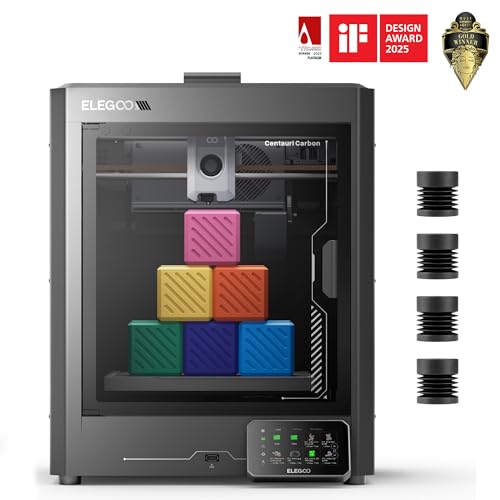

At a glance
| Elegoo Centauri Carbon 3D Printer | Creality K1 Max 3D Printer | |
|---|---|---|
| Our score | 7.9/10 | 6.7/10 |
| Best for | Makers wanting versatile printing of functional parts and larger models | Makers wanting versatile printing of functional parts and larger models |
| Not ideal for | Those chasing the finest miniature detail - a resin printer suits that better | Those chasing the finest miniature detail - a resin printer suits that better |
| Brand | Elegoo | Creality |
Build Volume and Print Size
Elegoo Centauri Carbon 3D Printer
This 3D printer offers a square build volume of 256 x 256 x 256 mm, making it suitable for medium-sized mechanical parts and larger display models. The cubic envelope supports taller objects provided they fit within the 256 mm height limit and the planned part footprint. The printer arrives fully assembled and pre-calibrated, enabling faster setup for larger prints. Though, layout planning is still needed for multi-part projects.
Creality K1 Max 3D Printer
How much can a user actually print at once? The stated build volume is 11.8 x 11.8 x 11.8 inches, which is the printer's maximum print size in all three axes. That equates to a square workspace that helps when users want functional parts, replacement housings, or small to medium cosplay items without splitting models. The chamber uses a flexible build plate for quick removal, but the model still must fit within the 11.8-inch limits, or it will require resizing and extra prints.
Print Speed and Quality
Elegoo Centauri Carbon 3D Printer
With an advertised print speed of up to 500 mm/s and acceleration of 20000 mm/s², the Elegoo is positioned for fast builds, particularly for larger parts where time matters. Speed is supported by a rigid die-cast frame, auto vibration compensation, and pressure advance, which work together to reduce streaks and uneven extrusion. For print quality, the printer includes an enclosed chamber with improved cooling and a heated bed, so PLA tends to adhere well and warp less. Consistent high-speed output still depends on model geometry and cooling conditions.
Creality K1 Max 3D Printer
The Creality rates the K1 Max for a maximum print speed of 600 mm/s, with an acceleration of 20000 mm/s², positioning it as a step up from more typical FDM printers. The Core XY design and a rigid frame are aimed at keeping motion steady, especially on larger parts. For first-layer reliability, the printer uses 1 um AI LiDAR to scan and can pause printing if alignment issues are detected. For surface quality, an upgraded Z-axis and G-sensor auto-tune are designed to reduce ringing and Z-banding, though results depend on model geometry and the chosen settings.
Filament Compatibility
Elegoo Centauri Carbon 3D Printer
Filament compatibility on the 3D printer is designed around PLA and then extends to more demanding materials. The manufacturer states it is tailored for "advanced filaments" and specifically highlights carbon fibre reinforced filament. It ships ready to print with PLA, and the enclosed chamber with improved cooling is intended to support use beyond basic plastics. For the Elegoo, the nozzle is described as a 320°C brass-hardened steel nozzle, which is positioned as helpful when moving to carbon fibre reinforced filament. Users should expect tougher parts, while PLA still requires the usual care for adhesion and heat control.
Creality K1 Max 3D Printer
Filament compatibility matters on the K1 Max because it is built for high-speed FDM work, and that usually changes results depending on the material used. The 3D printer can print with common FDM filaments, but performance depends on temperature requirements, cooling behaviour, and adhesion. The ceramic hotend heats to 200°C in 40s, so filaments that require higher melt temperatures may be limited (not stated). For safer prints, start with the manufacturer's recommended settings for each filament, then test small parts, since speed changes can affect stringing and layer strength. Cooling is improved by dual fans, which helps lower warping.
Build Plate and Levelling
Elegoo Centauri Carbon 3D Printer
Build plate performance and levelling set the start quality, particularly when printing PLA on a textured surface and later moving to more demanding filaments. The dual-sided build plate includes a PLA-specific surface designed to improve adhesion and limit warping. The printer arrives fully assembled and pre-calibrated, and it uses auto bed levelling, so the first-layer setup is usually quick. For best results, a simple routine is to power on, start the auto level, then run a small test square. If corners lift, the heated bed temperature and first-layer flow may need small adjustments.
Creality K1 Max 3D Printer
Before a reliable first layer, the build plate and levelling process matter most, because high-speed printing quickly exposes small bed-height issues. The Creality uses hands-free heatbed strain sensors for automatic leveling, and it adds an AI LiDAR scan to measure bed tilt at million points, then applies corrections before the first layer. It heats the heatbed to 60°C in about 90 seconds, so levelling can be carried out with stable temperatures. A flexible build plate also helps part removal. This reduces setup time, but sensor accuracy can be affected by debris.
Software and Slicer Compatibility
Elegoo Centauri Carbon 3D Printer
Software and slicer compatibility for the 3D printer is mainly about how easily it can take common G-code files and how well those settings suit its enclosed, high-speed FDM setup. Owners can slice STL files into G-code for this enclosed CoreXY printer with a 256 x 256 x 256 mm build volume, then print the resulting G-code from the onboard interface. For users finding it via the Amazon UK listing, the key check is whether slicer profiles support PLA at typical chamber temperatures.
Creality K1 Max 3D Printer
Software and slicer compatibility determines how consistently the 3D printer converts a model into high-speed FDM prints. Reliable results depend on whether slicer machine profiles and speed-related settings align with the printer's high-speed target of up to 600 mm/s and its acceleration of 20000 mm/s². The standard workflow is to select the correct machine profile, then set layer height and print temperature, and export the appropriate file format. If the slicer profiles are missing or outdated, slicing may not apply the intended speed limits, which can contribute to failed first layers. Firmware updates can also affect compatibility, so using the latest matching software profile is important.
Setup and Learning Curve
Elegoo Centauri Carbon 3D Printer
Although the Elegoo Centauri Carbon is designed to be straightforward, the setup still takes an organised first session, particularly for first-time users. The Elegoo review notes that the unit arrives assembled and pre-calibrated, so the early steps focus on placement, filament loading, and confirming auto bed levelling operates as expected. The typical first workflow starts with an auto bed level run, followed by loading PLA and checking that the touchscreen controls correspond to the selected profile.
Creality K1 Max 3D Printer
Despite the Creality K1 Max 3D being designed to be straightforward to set up, it still rewards careful preparation, particularly when targeting high-speed performance. Assembly arrives largely complete, with a boot-up quick guide and one-tap self-test, so beginners can begin sooner. Bed levelling is hands-free using strain sensors in the heatbed, while AI LiDAR scans bed tilt at million-point resolution to support accuracy. For best results, owners should run an initial first-layer test, confirm adhesion on the flexible plate, and tune print profiles before attempting 600 mm/s speeds.
Noise and Enclosure
Elegoo Centauri Carbon 3D Printer
Because the 3D printer uses an enclosed chamber, it can reduce drafts around the print area, which helps with consistency during longer sessions, particularly when printing PLA. The integrated enclosure also dampens some sound reaching the room, and the rigid die-cast frame helps limit vibration for steadier motion at high speeds. The main trade-off is heat build-up, so normal ventilation is important where the printer is positioned. The enclosure supports consistency, the camera adds a monitoring benefit, and the enclosed design can increase ambient warmth.
Creality K1 Max 3D Printer
Noise becomes an important consideration with the Creality, particularly because it is built for fast FDM printing, with a maximum print speed of 600 mm/s and 20000 mm/s² acceleration. Higher speed typically increases movement noise from the Core XY system and noise from the printhead fans, so quiet use is harder in shared rooms. The printer package itself does not specify a sound level or whether it includes an enclosure, so buyers need to plan space accordingly. A simple enclosure can cut some noise and reduce drafts that may affect prints. For "is the 3D printer any good, " expect louder operation compared with slower machines, but stable output with improved environmental control.
Cleaning and Maintenance
Elegoo Centauri Carbon 3D Printer
Cleaning and maintenance on the Elegoo are mainly about keeping the enclosed printing area, nozzle, and build surface in good condition, so prints stay consistent over time. In this review, routine care starts after each print, when residue on the dual-sided plate and around the chamber is removed gently with a soft brush. The nozzle should be wiped while warm, then any clogs cleared by running short test moves at normal settings. The PLA-specific surface benefits from light cleaning only, because abrasive scraping can reduce adhesion, especially when switching filaments. Finally, the enclosed airflow area should be checked for dust buildup.
Creality K1 Max 3D Printer
Cleaning and maintenance matter because the Creality is designed to run fast, so residue, dust, and filament debris can build up more quickly on the nozzle, fans, and build chamber. After prints, the hotend should cool fully, then loose strings can be brushed away from the nozzle area. The build plate should be wiped with a soft cloth, and stuck parts removed from the flexible plate carefully. Before major sessions, fan grills should be cleared and airflow paths checked for dust, since airflow affects cooling performance, and blockages can worsen surface finish. Periodic checks help prints stay consistent for owners using the 3D printer from Amazon UK.
Who Is This 3D Printer For?
Elegoo Centauri Carbon 3D Printer
Who is the 3D printer really suited for in the UK, and what kinds of prints does it handle best? It suits beginners and experienced makers who want a 256 x 256 x 256 mm FDM build, because it arrives fully assembled and pre-calibrated with auto bed levelling. It also fits people focused on speed, since its CoreXY design is intended for up to 500 mm/s for large, detailed parts. For buyers weighing whether this 3D printer is worth it, it is best matched to PLA printing, with carbon fibre reinforced filament handled via its enclosed chamber for stronger, lightweight results.
Creality K1 Max 3D Printer
This 3D printer is a good match for people who want a fast FDM printer and are willing to manage setup and part quality with a little care. It suits hobbyists, makers, and small shops that can benefit from a maximum speed of 600 mm/s, an 11.8 x 11.8 x 11.8 in build volume, and 1 um first-layer scanning. For buyers asking is the Creality any good, it often fits when reliability during long prints matters, since AI LiDAR and the AI camera can pause and alert. It is less ideal for complete beginners who want zero involvement.
Elegoo Centauri Carbon 3D Printer: pros
- 256 x 256 x 256 mm build volume
- Up to 500 mm/s print speed
- Automatic bed levelling
- Heated bed for better adhesion
- Supports PLA
Cons
- Slicing and first-layer setup take some learning
- Consumables (filament/resin, nozzles/FEP) add to running cost
Creality K1 Max 3D Printer: pros
- Up to 600 mm/s print speed
- Down to 1 microns layers
- Automatic bed levelling
- Heated bed for better adhesion
Cons
- Slicing and first-layer setup take some learning
- Consumables (filament/resin, nozzles/FEP) add to running cost
Our verdict
Our pick is the Elegoo Centauri Carbon 3D Printer (our score 7.9/10) - A FDM 3d printer (256 x 256 x 256 mm, 500 mm/s), a versatile choice for everyday printing. The Creality K1 Max 3D Printer is still worth it if it is cheaper when you check, or if it better matches your specific needs.