Elegoo Centauri Carbon 3D Printer vs Elegoo EU-EHJ-3DL-M5U Mars 5 Ultra 9K Resin 3D Printer
We compare the Elegoo Centauri Carbon 3D Printer and the Elegoo EU-EHJ-3DL-M5U Mars 5 Ultra 9K Resin 3D Printer across every dimension that matters - our scores, the key specs, and how each performs on the things you will actually notice day to day.
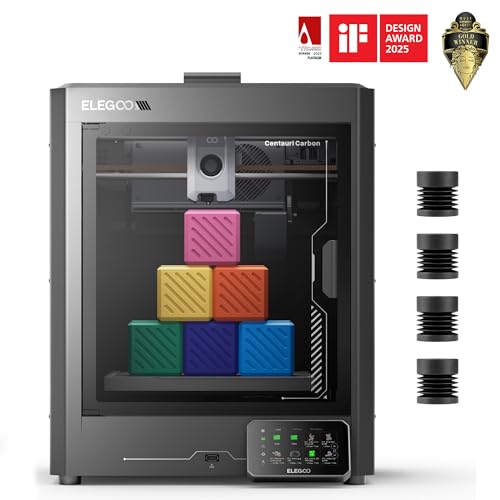

At a glance
| Elegoo Centauri Carbon 3D Printer | Elegoo EU-EHJ-3DL-M5U Mars 5 Ultra 9K Resin 3D Printer | |
|---|---|---|
| Our score | 7.9/10 | 8.9/10 |
| Best for | Makers wanting versatile printing of functional parts and larger models | Hobbyists printing highly detailed miniatures, figurines and models |
| Not ideal for | Those chasing the finest miniature detail - a resin printer suits that better | Anyone needing large or functional parts, or who can't manage resin washing, curing and ventilation |
| Brand | Elegoo | Elegoo |
Build Volume and Print Size
Elegoo Centauri Carbon 3D Printer
This 3D printer offers a square build volume of 256 x 256 x 256 mm, making it suitable for medium-sized mechanical parts and larger display models. The cubic envelope supports taller objects provided they fit within the 256 mm height limit and the planned part footprint. The printer arrives fully assembled and pre-calibrated, enabling faster setup for larger prints. Though, layout planning is still needed for multi-part projects.
Elegoo EU-EHJ-3DL-M5U Mars 5 Ultra 9K Resin 3D Printer
Build volume determines what models can actually be fitted and printed in one run, and it drives planning for parts, figurines, and prototypes. For this 3D printer, the manufacturer documentation in this review excerpt does not list the build volume or maximum print dimensions, so those measurements cannot be confirmed here. Size checks therefore need to be done by slicing in the included workflow and testing smaller models first, particularly for taller pieces and multi-part layouts. If a model exceeds the unknown limits, it must be split and reassembled.
Print Speed and Quality
Elegoo Centauri Carbon 3D Printer
With an advertised print speed of up to 500 mm/s and acceleration of 20000 mm/s², the Elegoo is positioned for fast builds, particularly for larger parts where time matters. Speed is supported by a rigid die-cast frame, auto vibration compensation, and pressure advance, which work together to reduce streaks and uneven extrusion. For print quality, the printer includes an enclosed chamber with improved cooling and a heated bed, so PLA tends to adhere well and warp less. Consistent high-speed output still depends on model geometry and cooling conditions.
Elegoo EU-EHJ-3DL-M5U Mars 5 Ultra 9K Resin 3D Printer
Even though print time depends on how a model is sliced, including layer exposure, support layout and whether the printer is set to faster or slower modes, the Elegoo is rated for up to 150mm/h printing speed. Speed is paired with fine detail: the printer uses an 18um XY resolution and an 18um layer-focused spec. For quality, it relies on a 7-inch mono LCD with 9K resolution. Faster modes may still require more careful support placement to maintain sharp edges and reduce flaws.
Filament Compatibility
Elegoo Centauri Carbon 3D Printer
Filament compatibility on the 3D printer is designed around PLA and then extends to more demanding materials. The manufacturer states it is tailored for "advanced filaments" and specifically highlights carbon fibre reinforced filament. It ships ready to print with PLA, and the enclosed chamber with improved cooling is intended to support use beyond basic plastics. For the Elegoo, the nozzle is described as a 320°C brass-hardened steel nozzle, which is positioned as helpful when moving to carbon fibre reinforced filament. Users should expect tougher parts, while PLA still requires the usual care for adhesion and heat control.
Elegoo EU-EHJ-3DL-M5U Mars 5 Ultra 9K Resin 3D Printer
Because the Mars 5 Ultra's print time and sharpness are strongly affected by the slicing setup and whether fast or slow modes are used, the choice of material also matters. However, this is a resin printer (The 3D printer), so filament compatibility is limited and FDM-style expectations do not apply. No filament types are specified, so the correct workflow is resin-led: select a UV resin that matches the LCD exposure approach typically chosen by the resin maker, then slice with the fast or slow modes accordingly. When comparing the Elegoo with FDM printers, only resin workflows apply, not spools.
Build Plate and Levelling
Elegoo Centauri Carbon 3D Printer
Build plate performance and levelling set the start quality, particularly when printing PLA on a textured surface and later moving to more demanding filaments. The dual-sided build plate includes a PLA-specific surface designed to improve adhesion and limit warping. The printer arrives fully assembled and pre-calibrated, and it uses auto bed levelling, so the first-layer setup is usually quick. For best results, a simple routine is to power on, start the auto level, then run a small test square. If corners lift, the heated bed temperature and first-layer flow may need small adjustments.
Elegoo EU-EHJ-3DL-M5U Mars 5 Ultra 9K Resin 3D Printer
A well-levelled build plate is central to achieving sharp details and consistent adhesion with the 3D printer, particularly because it uses a 7-inch mono LCD with an 18 um XY resolution. Small variations can show up clearly in fine features. On the Elegoo Mars 5 Ultra, automatic level support reduces setup steps by allowing self-check and automatic leveling after unboxing, followed by confirmation that the plate is seated correctly. If leveling fails, residue or warping risks increase, so leveling failure alerts can be important.
Software and Slicer Compatibility
Elegoo Centauri Carbon 3D Printer
Software and slicer compatibility for the 3D printer is mainly about how easily it can take common G-code files and how well those settings suit its enclosed, high-speed FDM setup. Owners can slice STL files into G-code for this enclosed CoreXY printer with a 256 x 256 x 256 mm build volume, then print the resulting G-code from the onboard interface. For users finding it via the Amazon UK listing, the key check is whether slicer profiles support PLA at typical chamber temperatures.
Elegoo EU-EHJ-3DL-M5U Mars 5 Ultra 9K Resin 3D Printer
After build plate and levelling are addressed, software choices become the next practical step. Slicer settings directly influence how a resin printer behaves on the Elegoo's 7-inch mono LCD with an 18 um XY resolution. For the 3D printer, Amazon UK listings typically rely on resin-suitable slicers that export the required file type, then match thickness and exposure to the layer height of 18 um. Strength comes from consistent preview and supports, while weakness appears when slicer profiles are missing or incorrectly applied, which can lead to failed adhesion or cure issues.
Setup and Learning Curve
Elegoo Centauri Carbon 3D Printer
Although the Elegoo Centauri Carbon is designed to be straightforward, the setup still takes an organised first session, particularly for first-time users. The Elegoo review notes that the unit arrives assembled and pre-calibrated, so the early steps focus on placement, filament loading, and confirming auto bed levelling operates as expected. The typical first workflow starts with an auto bed level run, followed by loading PLA and checking that the touchscreen controls correspond to the selected profile.
Elegoo EU-EHJ-3DL-M5U Mars 5 Ultra 9K Resin 3D Printer
Setting up the Elegoo 9K is usually straightforward, especially for users who want a fast start with minimal calibration. For the 3D printer, the main early steps involve unboxing, power on, and letting self-check and automatic leveling handle the baseline. Next, the user prepares the vat and build plate, then loads a resin profile that matches the printer's 7-inch 9K mono LCD and 18um XY resolution. During the learning phase, new users should expect a few trial prints, because exposure tweaks are often needed.
Noise and Enclosure
Elegoo Centauri Carbon 3D Printer
Because the 3D printer uses an enclosed chamber, it can reduce drafts around the print area, which helps with consistency during longer sessions, particularly when printing PLA. The integrated enclosure also dampens some sound reaching the room, and the rigid die-cast frame helps limit vibration for steadier motion at high speeds. The main trade-off is heat build-up, so normal ventilation is important where the printer is positioned. The enclosure supports consistency, the camera adds a monitoring benefit, and the enclosed design can increase ambient warmth.
Elegoo EU-EHJ-3DL-M5U Mars 5 Ultra 9K Resin 3D Printer
Once the printer is powered on and the self-check and automatic leveling have set a baseline, attention can shift to how the Mars 5 Ultra behaves in a workspace, especially sound and how well it is contained. In practical use, resin printers typically create noticeable operating noise from motion and fans, although specific decibel levels are not described. An enclosure can reduce perceived noise. Odour control is also influenced by how tightly the chamber is closed, so placing the printer in a dedicated enclosure or a separate room may be preferable, where background access and gaps are accounted for.
Cleaning and Maintenance
Elegoo Centauri Carbon 3D Printer
Cleaning and maintenance on the Elegoo are mainly about keeping the enclosed printing area, nozzle, and build surface in good condition, so prints stay consistent over time. In this review, routine care starts after each print, when residue on the dual-sided plate and around the chamber is removed gently with a soft brush. The nozzle should be wiped while warm, then any clogs cleared by running short test moves at normal settings. The PLA-specific surface benefits from light cleaning only, because abrasive scraping can reduce adhesion, especially when switching filaments. Finally, the enclosed airflow area should be checked for dust buildup.
Elegoo EU-EHJ-3DL-M5U Mars 5 Ultra 9K Resin 3D Printer
Cleaning and maintenance matter because resin work leaves residue on the build plate, the screen area, and the tools, and that residue can affect print quality over time. For this 3D printer price buyer, routine cleaning helps reduce curing artefacts. After each session, the operator removes the build plate carefully, wipes excess resin, and cleans tools using the appropriate solvent, then lets parts dry fully. The screen area also needs gentle, lint-free wiping, since smears can show on later layers. The operator should inspect the vat and film for debris, because trapped flakes can cause failures.
Who Is This 3D Printer For?
Elegoo Centauri Carbon 3D Printer
Who is the 3D printer really suited for in the UK, and what kinds of prints does it handle best? It suits beginners and experienced makers who want a 256 x 256 x 256 mm FDM build, because it arrives fully assembled and pre-calibrated with auto bed levelling. It also fits people focused on speed, since its CoreXY design is intended for up to 500 mm/s for large, detailed parts. For buyers weighing whether this 3D printer is worth it, it is best matched to PLA printing, with carbon fibre reinforced filament handled via its enclosed chamber for stronger, lightweight results.
Elegoo EU-EHJ-3DL-M5U Mars 5 Ultra 9K Resin 3D Printer
This printer is aimed at people who want high-detail resin prints and are comfortable using a resin workflow. The Elegoo Ultra 9K uses a 7-inch mono LCD with 9K resolution and an 18um XY resolution, which suits smaller, intricate models. It is a better fit for makers who can handle the correct setup needed for resin jobs, including residue detection, levelling, and error monitoring via the AI camera. It also targets teams that want Wi-Fi cluster printing across multiple units. The resin process can feel demanding for beginners.
Elegoo Centauri Carbon 3D Printer: pros
- 256 x 256 x 256 mm build volume
- Up to 500 mm/s print speed
- Automatic bed levelling
- Heated bed for better adhesion
- Supports PLA
Cons
- Slicing and first-layer setup take some learning
- Consumables (filament/resin, nozzles/FEP) add to running cost
Elegoo EU-EHJ-3DL-M5U Mars 5 Ultra 9K Resin 3D Printer: pros
- Down to 18 microns layers
- Excellent fine detail and smooth surfaces
Cons
- Resin needs washing, UV curing and good ventilation
- Smaller build volume than most FDM printers
- Consumables (filament/resin, nozzles/FEP) add to running cost
Our verdict
Our pick is the Elegoo EU-EHJ-3DL-M5U Mars 5 Ultra 9K Resin 3D Printer (our score 8.9/10) - A resin 3d printer, a detail-focused choice for miniatures and detailed models. The Elegoo Centauri Carbon 3D Printer is still worth it if it is cheaper when you check, or if it better matches your specific needs.